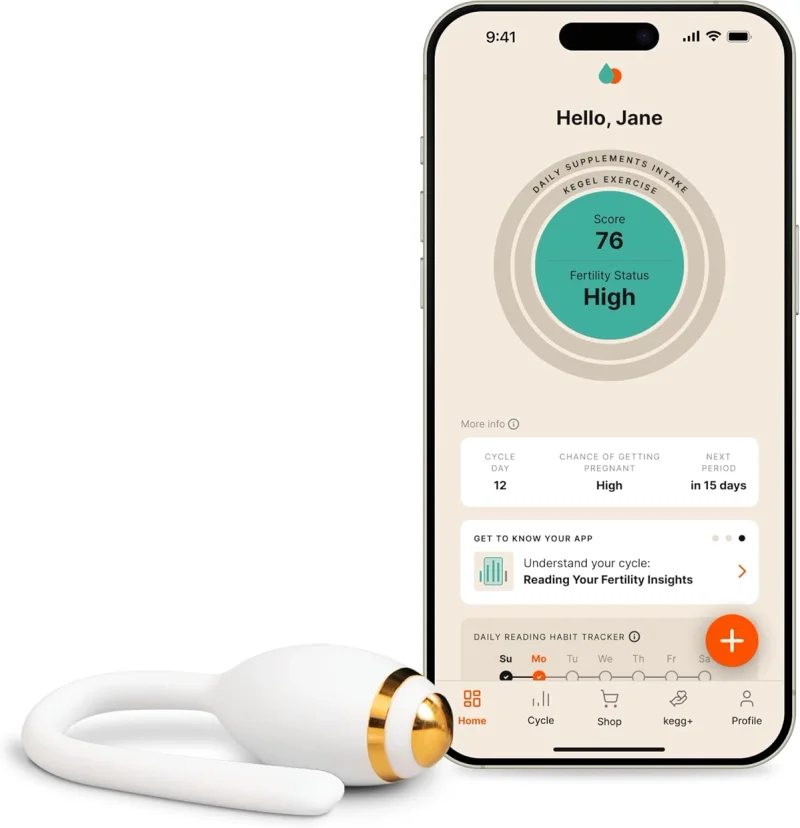
kegg Fertility Tracker with Free App - Gold Edition
The kegg Fertility Tracker uses cervical mucus analysis to predict your fertile window up to 7 days in advance, offering a one-time purchase alternative to disposable ovulation tests. With 2-minute daily readings and optional kegel exercise tracking, it's designed for women trying to conceive naturally.
As an Amazon Associate, we earn from qualifying purchases
What We Love
- One-time purchase with no monthly subscription fees or refill costs
- Predicts fertile window 5-7 days in advance vs. 1-2 days for ovulation tests
- Tracks cervical mucus - the most reliable fertility indicator
- 2-minute daily reading fits easily into any routine
- Doubles as a kegel exercise tracker with guided pelvic floor workouts
- FSA/HSA eligible for tax-free purchase
- Comprehensive free app with cycle insights and personalized fertility scores
Consider This
- High upfront cost at $269 may be prohibitive for some budgets
- Mixed reports on battery life - some units stop charging properly
- Requires consistent daily use for accurate predictions
- Learning curve to interpret cervical mucus readings correctly
- Not suitable for women with very irregular cycles or PCOS
- Some users report the device doesn't work as expected with no clear reason
Our In-Depth Review
Understanding Fertility Tracking: Why kegg Takes a Different Approach
For couples trying to conceive, timing is everything. Research shows that approximately 75% of couples miscalculate their fertile window, leading to months of unsuccessful attempts and mounting frustration. The kegg Fertility Tracker promises to solve this problem by tracking cervical mucus—what fertility experts consider the gold standard for predicting ovulation. After analyzing extensive user feedback and comparing it to traditional ovulation prediction methods, we're breaking down whether this $269 device is worth the investment for your conception journey.
What Makes kegg Different from Other Fertility Trackers?
The fertility tracking market is flooded with options: ovulation test strips, basal body temperature thermometers, wearable trackers, and smartphone apps. So what sets kegg apart?
The key difference lies in what kegg measures. While most devices track indirect fertility signals (temperature changes, hormone levels in urine), kegg directly analyzes your cervical fluid—the substance that makes pregnancy physically possible. Without fertile-quality cervical mucus, sperm cannot survive the journey through the reproductive tract to reach the egg. By monitoring changes in cervical fluid electrolyte patterns, kegg can predict your fertile window up to 7 days before ovulation occurs.
This advanced warning is crucial. Sperm can survive in fertile cervical fluid for up to 5 days, meaning intercourse several days before ovulation can still result in pregnancy. Traditional ovulation predictor kits only detect the LH surge 12-36 hours before ovulation—often too late to maximize your chances.
How kegg Works: The Science Behind Cervical Mucus Tracking
Understanding how kegg works requires a brief biology lesson. Throughout your menstrual cycle, cervical fluid changes in consistency, volume, and electrolyte composition in response to hormonal fluctuations.
The Cervical Mucus Cycle
Infertile Phase (Post-Menstruation): Cervical mucus is thick, tacky, or minimal. The electrolyte pattern creates high impedance readings on the kegg sensor.
Approaching Fertility: As estrogen rises, cervical fluid becomes creamier and more abundant. Electrolyte levels shift, causing impedance readings to change.
Peak Fertility: Near ovulation, cervical mucus transforms into a clear, stretchy, egg-white consistency. This fertile-quality mucus has a distinctive electrolyte pattern that kegg's sensors can detect. Impedance readings reach their lowest point.
Post-Ovulation: After ovulation, progesterone causes cervical fluid to become thick and sticky again. Impedance readings rise back to higher levels.
kegg's Sensing Technology
The kegg device contains sophisticated impedance sensors that measure the electrical resistance of cervical fluid. By tracking these measurements over time, the kegg algorithm identifies patterns specific to your unique cycle and predicts when you're entering your fertile window.
This technology has been clinically validated in research studies, showing strong correlation with traditional fertility monitoring methods while providing earlier predictions.
Unboxing and First Impressions
The kegg arrives in elegant packaging befitting its premium price point. Inside, you'll find the kegg device itself (available in gold or white), a charging cable, user guide, and quick-start instructions.
The device is sleek and discreet, measuring approximately 5 inches long with a smooth, body-safe silicone surface. The gold finish adds a touch of luxury, though the color is purely aesthetic and doesn't affect functionality.
Initial setup requires downloading the free kegg app (iOS and Android compatible), creating an account, and pairing the device via Bluetooth. The process is straightforward and takes about 10 minutes.
Using kegg: The Daily Routine
One of kegg's selling points is convenience—readings take just 2 minutes daily. Here's what the actual experience looks like:
Daily Reading Process
Step 1: Open the kegg app and select whether you want to do kegel exercises or just take a fertility reading.
Step 2: Insert the kegg device as you would a tampon, following the app's visual guide for proper positioning.
Step 3: The device automatically begins taking measurements. If you selected the kegel option, the app guides you through pelvic floor exercises during this time.
Step 4: Wait for the 2-minute reading to complete. The app displays a progress indicator.
Step 5: Remove the device, rinse it with water and mild soap, and allow it to air dry.
The entire process, including cleanup, takes approximately 5 minutes. Most users incorporate it into their morning or evening routine, similar to brushing teeth.
Best Practices for Accurate Readings
For optimal accuracy, kegg recommends:
- Taking readings at approximately the same time each day
- Ensuring the device is fully inserted (similar to tampon placement)
- Avoiding readings immediately after intercourse or during heavy arousal
- Consistency—missing multiple days can affect prediction accuracy
The kegg App: Understanding Your Fertility Score
After each reading, the app displays your "Fertility Score" on a scale of 0-100, along with your current fertility status: Low, High, or Peak.
Interpreting Your Results
Scores 0-40 (Low Fertility): Your cervical fluid pattern indicates you're not currently in your fertile window. This occurs during menstruation, immediately post-period, and after ovulation.
Scores 41-75 (High Fertility): Your body is approaching ovulation. Cervical fluid is becoming more fertile-quality. This is when kegg's advanced warning becomes valuable—you're entering your fertile window.
Scores 76-100 (Peak Fertility): Optimal time for conception. Cervical fluid has reached its most fertile state, indicating ovulation is imminent or occurring.
The app also displays helpful information including:
- Predicted next period date
- Current cycle day
- Chance of getting pregnant (Low/High/Peak)
- Fertile window countdown
- Historical cycle data and pattern recognition
Cycle Insights and Pattern Learning
Over time, the kegg algorithm learns your unique patterns. The first month provides baseline data, and predictions typically improve significantly by cycles 2-3 as the app understands your specific hormonal rhythms.
The app includes educational resources explaining what your readings mean and tips for timing intercourse to maximize conception chances.
Real-World Accuracy: What Users Report
Customer feedback on kegg's accuracy is generally positive, with many users praising how it predicted their fertile window several days in advance.
Positive experiences include:
- Women who successfully conceived after using kegg to time intercourse
- Accurate predictions matching ovulation confirmed by later pregnancy tests
- Fuller understanding of personal cycle patterns than previous tracking methods provided
- Appreciation for the advance warning compared to standard ovulation tests
However, accuracy experiences aren't universal. Some users report:
- Inconsistent readings that don't align with other fertility signs
- Difficulty interpreting whether scores accurately reflect their fertility status
- Challenges using kegg with irregular cycles or hormonal conditions
The variance in experiences appears related to individual factors like cycle regularity, proper device usage, and consistency of daily readings.
The Kegel Exercise Feature: A Valuable Bonus
Beyond fertility tracking, kegg includes guided kegel exercise routines—a feature particularly valuable for women planning pregnancy and postpartum recovery.
How Kegel Tracking Works
When you select the kegel option before your reading, the app guides you through pelvic floor exercises while the device is inserted. The kegg's sensors detect pelvic floor muscle contractions, providing real-time feedback on your technique.
The app offers different exercise routines:
- Beginner programs for those new to kegel exercises
- Advanced routines for experienced users
- Customizable workout duration
Benefits of Strong Pelvic Floor Muscles
For women trying to conceive and throughout pregnancy, maintaining pelvic floor strength offers multiple benefits:
- Improved bladder control during pregnancy
- Easier labor and delivery
- Faster postpartum recovery
- Enhanced sexual function
While this isn't kegg's primary purpose, many users appreciate the dual functionality, especially given the premium price point.
Cost Analysis: Is kegg Worth $269?
At $269, kegg represents a significant upfront investment. Let's break down the value proposition.
Comparing Costs Over Time
Traditional Ovulation Tests: Budget-friendly at $10-20 per month, but costs accumulate. Over 6 months of trying to conceive (average for 80% of couples), you'll spend $60-120. Over 12 months: $120-240.
Smart Basal Body Thermometers: Range from $100-300 for the device, plus potential subscription fees ($5-10/month) for premium app features.
Fertility Monitors (like ClearBlue): Device costs $100-150, plus required test stick refills at $30-50 per month. Over 6 months: $280-450 total.
Doctor-Monitored Cycles: Ultrasound monitoring and blood tests can cost $500-4,800 per cycle without insurance coverage.
kegg: One-time purchase of $269. No refills, no subscriptions, no recurring costs. You can use it indefinitely.
For couples who conceive within 3-6 months, kegg's cost is comparable to or slightly higher than alternatives. For those trying longer (6-12+ months), kegg becomes the more economical choice since there are no ongoing expenses.
Additionally, kegg is FSA/HSA eligible, allowing you to purchase it with pre-tax dollars if you have a flexible spending or health savings account.
Battery Life: A Significant Concern
One of the most frequently mentioned issues in customer reviews involves battery performance, and this deserves serious attention.
Positive reports describe the battery lasting weeks between charges with daily use—convenient and reliable.
However, concerning reports include:
- Devices that stop holding a charge within months of purchase
- Units that won't charge beyond 50-60% battery
- Some devices that fail to charge at all after the first few uses
These battery issues appear sporadic rather than universal, suggesting possible quality control inconsistencies. When the battery works properly, users are delighted. When it doesn't, the device becomes unusable and frustrating.
kegg offers a warranty, but dealing with a malfunctioning device during an already stressful time (trying to conceive) adds unnecessary frustration.
Tips for Maximizing Battery Life
Based on user experiences, these practices may help:
- Fully charge the device before first use
- Avoid leaving it plugged in continuously after reaching full charge
- Store at room temperature (excessive heat or cold can damage batteries)
- Contact customer service immediately if you notice charging issues
The kegg Community: Support When You Need It
One valuable but often overlooked aspect of kegg is access to their private user community. This online forum connects kegg users who share experiences, troubleshoot issues, and support each other through the trying-to-conceive journey.
Community benefits include:
- Chart sharing and interpretation help from experienced users
- Success stories (BFPs - "big fat positives") that provide hope and motivation
- Tips and tricks for getting the most accurate readings
- User support specialists who answer questions and provide chart insights
- Emotional support from others who understand the TTC (trying to conceive) experience
For many users, this community becomes as valuable as the device itself, particularly during the emotionally challenging process of trying to conceive.
Who Should Consider kegg?
kegg is best suited for:
Women with regular cycles (25-35 days) who want to maximize conception chances by identifying their full fertile window, not just the day of ovulation.
Couples who've been trying for several months without success and want more precise timing information than calendar methods or apps provide.
Women avoiding hormonal birth control who need accurate fertility awareness for natural family planning.
FSA/HSA account holders who can purchase kegg with pre-tax dollars, reducing the effective cost.
Those tired of monthly ovulation test expenses who want a one-time investment that pays for itself over time.
Women interested in pelvic floor health who value the bonus kegel tracking functionality.
Who Might Want to Consider Alternatives?
kegg may not be ideal for:
Women with very irregular cycles or PCOS (Polycystic Ovary Syndrome), as erratic hormonal patterns can make cervical mucus tracking less reliable.
Those on a tight budget who can't afford the $269 upfront cost, even if it's more economical long-term.
Couples just starting to try who may want to begin with less expensive methods before investing in premium tracking tools.
Women uncomfortable with internal devices who would prefer external tracking methods like wearable temperature trackers.
Those needing medical-grade fertility monitoring due to known fertility challenges—in these cases, doctor-supervised monitoring may be more appropriate.
Comparing kegg to Competitors
kegg vs. Tempdrop (Wearable BBT Tracker)
Tempdrop tracks basal body temperature continuously via an armband worn during sleep. It's less invasive than kegg but only confirms ovulation after it occurs (based on temperature rise), rather than predicting it in advance. Tempdrop costs $159-199 with no recurring fees.
kegg vs. Mira Fertility Tracker
Mira measures actual hormone levels in urine (not just LH surge) using reusable wands. It provides precise hormone data but requires monthly wand purchases ($50-60). Over time, Mira becomes significantly more expensive than kegg.
kegg vs. OvuSense
OvuSense is an internal sensor worn overnight that tracks continuous core body temperature. It offers 24 hours' advance prediction of ovulation. OvuSense costs $299-449 depending on the package, with optional subscription features. It's comparable in price to kegg but doesn't include kegel exercise functionality.
kegg's unique advantage is cervical mucus tracking—considered by fertility specialists to be the most reliable indicator of current fertility status.
Potential Drawbacks and Limitations
To provide a balanced perspective, here are honest limitations:
Not foolproof: No at-home fertility tracker is 100% accurate. kegg improves your odds but can't guarantee conception.
Requires commitment: Daily 2-minute readings are necessary. Sporadic use reduces accuracy significantly.
Quality control concerns: The battery issues reported by some users suggest inconsistent manufacturing quality.
Not diagnostic: kegg tracks fertility signs but doesn't diagnose fertility problems. If you've been trying for 12+ months (or 6+ months if over 35), consult a fertility specialist.
Learning period: Expect the first cycle or two to be less accurate as the algorithm learns your patterns.
Tips for Success with kegg
Based on extensive user feedback, follow these recommendations:
Be consistent: Take readings daily at approximately the same time for best results.
Give it time: Don't judge effectiveness based solely on your first cycle. Accuracy improves as the app learns your patterns.
Track additional signs: While cervical mucus is highly reliable, combining kegg data with awareness of other fertility signs (cervical position, mittelschmerz pain) provides the fullest picture.
Join the community: The private user group offers invaluable chart interpretation help and emotional support.
Combine with prenatal preparation: Use the months TTC to optimize your health—take prenatal vitamins, maintain healthy weight, reduce stress.
Don't stress about perfection: Missing an occasional reading won't ruin your data. The algorithm accounts for gaps.
Contact support quickly: If you experience battery issues or readings that don't make sense, reach out to customer service immediately rather than waiting.
The Emotional Side of Trying to Conceive
Beyond the technical aspects, it's worth addressing the emotional reality of TTC. The process can be stressful, isolating, and emotionally draining, especially as months pass without success.
Many kegg users report that having concrete data reduces anxiety. Instead of wondering "am I timing this right?", kegg provides clear guidance, helping you feel more in control during an uncertain process.
The community aspect also addresses the isolation many feel. Connecting with others on the same journey—sharing frustrations, celebrating BFPs, and supporting each other through disappointments—adds significant value beyond the device's tracking capabilities.
Environmental and Practical Advantages
Beyond fertility tracking, kegg offers practical benefits worth considering:
Waste reduction: Eliminates monthly disposable ovulation tests, reducing plastic waste.
Convenience: No trips to the pharmacy for test refills, no worrying about running out during your fertile window.
Portability: Small and discreet, easily packed for travel without needing bulky test supplies.
Privacy: No packaging or test sticks that might be seen by others, maintaining discretion.
Final Verdict
The kegg Fertility Tracker represents a sophisticated approach to conception timing, using clinically validated cervical mucus analysis to predict your fertile window days in advance. For women with regular cycles who are committed to daily tracking, it offers genuine advantages over traditional ovulation prediction methods.
The one-time purchase model makes financial sense for anyone trying to conceive for more than a few months, and the FSA/HSA eligibility further improves the value proposition. The bonus kegel tracking functionality adds utility beyond fertility monitoring.
However, the device isn't without concerns. Battery life issues reported by some users are troubling, and the high upfront cost may be prohibitive for budget-conscious couples. Additionally, kegg works best for women with relatively regular cycles—those with PCOS or highly irregular cycles may not see the same accuracy.
The strongest endorsement comes from users who successfully conceived using kegg, crediting the advanced fertile window predictions with helping them time intercourse correctly after months of unsuccessful attempts. For these couples, the $269 investment paid for itself many times over by shortening their time to conception.
Our Rating
Overall: 4 out of 5 stars
Accuracy: 4/5 - Strong for regular cycles, less reliable for irregular patterns
Ease of Use: 4.5/5 - Quick 2-minute readings, intuitive app
Value: 4/5 - Excellent long-term value if it works, but high upfront cost
Build Quality: 3.5/5 - Beautiful design but concerning battery reports
Features: 5/5 - Comprehensive app, kegel tracking, community access
Customer Support: 4/5 - Generally responsive with helpful chart insights
We recommend kegg for couples actively trying to conceive who have a few hundred dollars to invest in maximizing their chances. It's particularly valuable for those who've been trying for 3+ months without success and want more precise timing data. The cervical mucus tracking provides information that other at-home methods simply can't match.
However, start with budget-friendly ovulation tests if you're just beginning your TTC journey or aren't sure you're ready for the financial commitment. You can always upgrade to kegg later if needed.
For women with regular cycles who are committed to consistent daily tracking, kegg offers a legitimate advantage in the conception journey—transforming guesswork into data-driven timing that could mean the difference between another month of disappointment and the positive pregnancy test you've been hoping for.